
NewsDetails
Cooling Tower Fill Media: Material, Design and Maintenance Guide
author:Jinyang time:2026-07-06 00:00:00 Click:120
Fill media is the heart of a cooling tower. It increases the contact area between warm water and air, and directly determines thermal performance, drift loss and resistance. Choosing the right fill material and sheet style is therefore more important than the tower shell. This guide explains how cooling tower fill works, the most common materials, and how to specify and maintain them.
How Fill Media Works
Warm water is distributed over the fill in thin films that flow downward over corrugated sheets, while air moves upward through the same stack. Heat transfers from the water to the air by conduction and evaporation. A good fill maximizes the water film area while keeping air resistance low. Blocked, scaled or aged fill reduces tower efficiency by 10-30 percent.
Common Fill Materials
| Material | Max Temperature | Use |
|---|---|---|
| PVC (Polyvinyl Chloride) | 50-60°C | Most standard cooling towers, counterflow |
| CPVC | 70-80°C | Higher temperature water, industrial towers |
| PP (Polypropylene) | 80-90°C | Hot water, high dirt / oil loads |
| FRP / Cement | High | Old-style splash fill, rough service |
Fill Styles
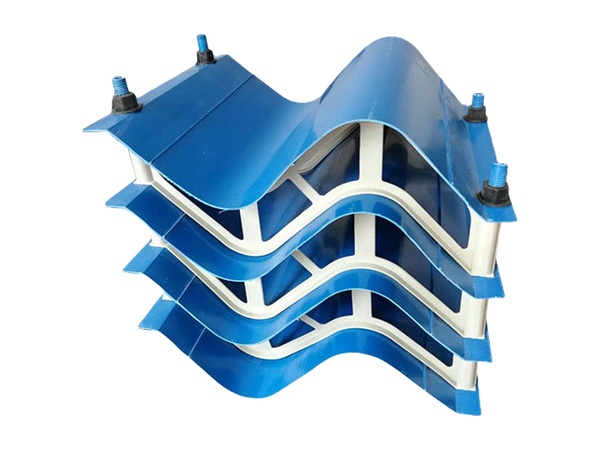
Film fill (corrugated sheets bonded in blocks) gives the highest efficiency and is the standard for modern towers. Splash fill breaks water into droplets and is used where water is dirty, oily or laden with fibers that would block film fill. Trickling grids are used in very high temperature or heavy fouling service.
Selection Checklist
Before ordering replacement fill, confirm: water temperature range, water quality (chlorine, oil, solids), air velocity through the fill, support beam spacing, and the exact block dimensions of the existing fill. Standard block thickness is 150 mm to 300 mm; sheets are usually 0.3-0.5 mm thick with an embossed surface to keep sheets apart.
Maintenance and Replacement
Inspect fill every shutdown. Biological fouling, calcium scale and algae reduce efficiency; clean with low-pressure washing, never with high-pressure jetting, which can damage sheets. Fill should be replaced when sheets become brittle, deformed, or heavily encrusted. With normal treated water, PVC fill lasts 8-12 years; PP fill 10-15 years. Always support fill on a FRP or stainless grid, not directly on steel angles that can rot through.
Conclusion
Correct fill material, style and support directly control cooling tower efficiency and lifetime. Hebei Jinyang Environmental Protection Equipment Co., Ltd. supplies PVC, CPVC and PP cooling tower fill in standard and custom block sizes, plus FRP support grids and drift eliminators.
References
CTI ATC-105 — Acceptance Test Code for the Performance of Mechanical Draft Cooling Towers
 Recommended Products
 Contact us
—— Contact:Ms. Wang
—— Tel:+86 19948391999
—— Email:JYFRP@outlook.com
—— Url:https://www.jinyanggep.com
—— Address:Zaoqiang County, Hengshui City, Hebei Province